When you think of lower-body exercises, quads, hamstrings, glutes, and calves are the top-of-mind muscle groups to work, right? Well, yes and no. Each of these muscle groups are important and depending on the runner one group may need to be worked more than another. But, there's an entirely different group of muscles that often get overlooked by most runners. These muscles (abductors and adductors) are found laterally on the outside and inside of the legs. There is not one abductor and one adductor muscle, rather they are a collection of different muscles that work to pull the legs away from or toward the body or to create internal or external rotation of the leg. They also work to provide stability and balance in the lower body. The glute medius muscle is a hip-abductor muscle that provides stability in the whole pelvic region when walking and running. It's when this muscle is tight or weak that often results in runners knee. Adductors running down the inside of the leg help provide stability as well as help with acceleration when running. Adductors are the only muslces in the lower-body that are continuously firing throughout the entire running stride cycle. Keeping these muscle groups well conditioned will not only help make you a more efficient runner, it will help decrease the chance of injury and falling. The video below shows five simple exercises that are very effective in working your abductor and adductor muscles. Check it out!

Wednesday, August 19, 2015


Tuesday, August 18, 2015
The Orange: Great Last Minute Pre-Run Fuel


Upper-Body and Core Workout for Runners
Like yesterday's Lower-Body/Core HIIT, this Upper-Body/Core HIIT workout is perfect for runners. A HIIT (High Intensity Interval Training) workout doesn't take much time, but gives a lot of bang for your bucks. The workout consists of 6 exercises-3 core and 3 upper-body. Complete each exercise for 20 secs moving from one exercise directly into the next exercise, taking no rest in between. After completing the 6th exercise, take a 1-minute rest break, then repeat the HIIT in the same fashion for a total of 5 rounds. The whole workout takes only 20 minutes. This format jacks up the heart rate ramping up your metabolism. The exercised selected in this workout target the core and upper-body muscle groups that help support and ensure good running form. The only equipment needed is a mat (or carpeted area) and some light dumbbells. Give it a try! Tomorrow I'll post some great lateral movement lower-body exercises that help prevent injury and increase stability and balance, all important to good running, so check that one out too! Check out my other workouts for runners on YouTube.
Monday, August 17, 2015
Potatoes: A Great Food for Runners!

 Running
and pasta are like Bert & Ernie, Yin & Yang, Lavern & Shirley,
Thelma & Louise. That's all well and fine. Pasta is a great source of carbs
for fueling your runs, but did you know that thepotato
is a nutritious source of carbohydrates,
even more than rice or pasta? Yep, this often shunned veggie has gotten a bad
wrap in the whole anti-carb movement. Like many foods, it's how you prepare it
that makes or breaks the nutritional value of the spud. Cover it with butter,
melted cheese, and bacon bits and you've created "food porn." Bake it
and top it with a dollop of Greek yogurt and voilà,
nutritious yumminess! Sport nutritionist Nancy Clark supports the spud
too. She shares that this super veggie
is a great source of Vitamin C (gives
1/2 of your daily needs) and provides the potassium you'd
lose in three hours of sweaty exercise. It's cousin the sweet potato provides
even more health benefits! A standard
potato (like
you'd get with a restaurant meal) contains
around 200 calories. That's about the same as most sports bars. The spud makes
a great pre-and post-run snack as well as a part of a meal. Pre-baked spuds
that are sliced and refrigerated make great snacks before or after a run. In her book, NancyClark's Food Guide for Marathoners, she
gives some great ideas for potato toppers such as low-fat salad dressing;
low-fat sour cream, chopped onion, and low-fat shredded cheddar cheese; cottage
cheese and garlic powder; milk mashed into the potato; plain yogurt (I
like using the Greek yogurt. It's very similar to sour cream);
flavored vinegars; soy sauce; steamed veggies like broccoli; chopped jalapeno
peppers; lentils or lentil soup (I
like topping it with veggie chili or black beans);
applesauce. Worried about the potato
being high on the Glycemic Index? Valid concern, but did you know that when you
pair the spud with certain foods, it actually lowers its GI? Adding healthy
fats to your spud such as olive oil, sour cream or avocados, will lower the GI.
Increasing the acidity by adding vinegar, citrus or salsa lowers the GI of the
spud too. Eating the potato with the skin on increased the fiber slowing
digestion and lowering the GI. Oddly enough, cooking the potato, then cooling
it before you eat it, lowers the GI. So, give the spud a try!!
Running
and pasta are like Bert & Ernie, Yin & Yang, Lavern & Shirley,
Thelma & Louise. That's all well and fine. Pasta is a great source of carbs
for fueling your runs, but did you know that thepotato
is a nutritious source of carbohydrates,
even more than rice or pasta? Yep, this often shunned veggie has gotten a bad
wrap in the whole anti-carb movement. Like many foods, it's how you prepare it
that makes or breaks the nutritional value of the spud. Cover it with butter,
melted cheese, and bacon bits and you've created "food porn." Bake it
and top it with a dollop of Greek yogurt and voilà,
nutritious yumminess! Sport nutritionist Nancy Clark supports the spud
too. She shares that this super veggie
is a great source of Vitamin C (gives
1/2 of your daily needs) and provides the potassium you'd
lose in three hours of sweaty exercise. It's cousin the sweet potato provides
even more health benefits! A standard
potato (like
you'd get with a restaurant meal) contains
around 200 calories. That's about the same as most sports bars. The spud makes
a great pre-and post-run snack as well as a part of a meal. Pre-baked spuds
that are sliced and refrigerated make great snacks before or after a run. In her book, NancyClark's Food Guide for Marathoners, she
gives some great ideas for potato toppers such as low-fat salad dressing;
low-fat sour cream, chopped onion, and low-fat shredded cheddar cheese; cottage
cheese and garlic powder; milk mashed into the potato; plain yogurt (I
like using the Greek yogurt. It's very similar to sour cream);
flavored vinegars; soy sauce; steamed veggies like broccoli; chopped jalapeno
peppers; lentils or lentil soup (I
like topping it with veggie chili or black beans);
applesauce. Worried about the potato
being high on the Glycemic Index? Valid concern, but did you know that when you
pair the spud with certain foods, it actually lowers its GI? Adding healthy
fats to your spud such as olive oil, sour cream or avocados, will lower the GI.
Increasing the acidity by adding vinegar, citrus or salsa lowers the GI of the
spud too. Eating the potato with the skin on increased the fiber slowing
digestion and lowering the GI. Oddly enough, cooking the potato, then cooling
it before you eat it, lowers the GI. So, give the spud a try!!Lower-Body and Core Workout for Runners
This Lower-Body/Core HIIT workout is perfect for runners. A HIIT (High Intensity Interval Training) workout doesn't take much time, but gives a lot of bang for your bucks. The workout consists of 6 exercises-3 core and 3 lower-body. Complete each exercise for 20 secs moving from one exercise directly into the next exercise, taking no rest in between. After completing the 6th exercise, take a 1-minute rest break, then repeat the HIIT in the same fashion for a total of 5 rounds. The whole workout takes only 20 minutes. This format jacks up the heart rate ramping up your metabolism. The exercised selected in this workout target the core and all the major muscle groups in the lower body. The only equipment needed is a mat (or carpeted area) and a medicine ball. Don't have a medicine ball? No problem, use a large detergent bottle or fill an empty 1-gallon milk jug with water to use as your weight. Give it a try! Tomorrow I'll post an Upper-Body/Core HIIT for Runners, so check that one out too! Check out my other workouts for runners on YouTube.
Friday, June 26, 2015
Running Rub You the Wrong Way?

rash or chafing. you know it's no fun. There's nothing worse than being out on a 10-mile run and halfway through you realize the skin between your legs, in the nether region, is ready to ignite. Well, maybe not realizing you've actually chafed until after the run when the shower water hits the irritated area and you scream bloody murder bringing the entire family into the bathroom, is worse...not that that's ever happened to me.
So, who gets it and why? Really it can effect anyone. Overweight and skinny, new runner and seasoned. Everyone is fair game. Typically chafing is caused by friction between skin and fabric, but it can also be caused by skin-on-skin. Men often experience the skin/fabric irritation at the nipple area on the chest. I've seen a few male runners finish a marathon looking like victims of drive-by shootings with two red dots centered on both pecs followed by a bloody trail down their singlets to their shorts. Not a pretty sight. Women often experience similar chafing in various areas around the straps of their jog bras. I once ran shirtless in only my running shorts, socks, shoes, and my hydration belt. The run went fine. When I later got in the shower I discovered (the whole family did too when I screamed in pain as the shower water hit me) that I had a huge welt at my waist where the belt rubbed me raw and I didn't even know it.
Skin-on-skin chafing often happens between the thighs, but it can happen elsewhere too. Heat and humidity often make great conditions for chafing. So, those of us living in the hot humid South of the USA, are well aware of summer chafing woes.
Below are a few tips for how to prevent chafing and how to deal with it if you already have it.
1. Wear clothing with a closer fit. Men, I've found that singlets and running shirts that fit more snugly in the chest area, reduces the movement of the fabric therefore decreasing the friction between the fabric and your nips. Also, pay more attention to the fabric of your shirts. Not all technical fabrics are the same. Most technical running shirts are made of 100% polyester. Even though two different shirts may be made of `100% polyester, the design of the weave can really make a difference in moisture management and texture. The weave of the fabric can really play a big part in whether it's abrasive or not to your skin. So, when you're in the running store, don't just buy the coolest looking shirt. Buy the one with the softest fabric. Many technical compression shirts incorporate Lycra or spandex in with the polyester which makes it stretchy and softer. Now I'm not a big fan of the compression shirts that are so tight I feel like a sausage casing when I put it on and start to wheeze because I can't expand my lungs enough to get in air, but I have found they can be useful in decreasing friction. However, when I buy a compression shirt or singlet, I don't buy it for the compression, I buy it for a closer fit. So even though I usually wear a men's small in a normal shirt, in a compression shirt I'll often get a Large. The large doesn't squeeze the life out of me but it gives me a closer fit than a regular shirt.
Same idea applies to shorts. Running shorts with a lot of excessive fabric may increase the chance of chafing. Also, shorts with a really long crotch may allow skin-on-skin contact that can cause chafing for some. So, buy shorts with minimal leg fabric. Compression shorts are also a good option in reducing fabric-on-skin friction. I see ladies wearing compression shorts and 3/4 running tights all the time. Guys if you don't want all the world to see your manhood, you can wear the compression shorts underneath a pear of running shorts. I've found, if I'm going to do that, cutting out the built in liner of the running shorts is more comfortable when pairing running shorts with compression shorts.
 2. Cover it up. Tried altering your clothing and still having chafing issues? Then try covering the affected area(s) with a physical barrier. To protect your nips, try covering them with bandaids. The circular bandaids work well. I've discovered that the waterproof bandaids work best, especially if you sweat heavily. They work so well, in fact that once I used them I discovered I had two water balloons on my chest after finishing a marathon. Kind of embarrassing, but funny too. Felt kind of like a stripper with pasties. Another neat trick it to use Dr. Scholl's moleskin and cut your own round protective covers to place over your nips. The off-brand moleskin tends not to stick as well or as long, so pay a little more for the Dr. Scholl's. There are also products such as NipGuards and NipEAZE which are similar to bandaids, but desigend especially for runners to protect runners' nipples.
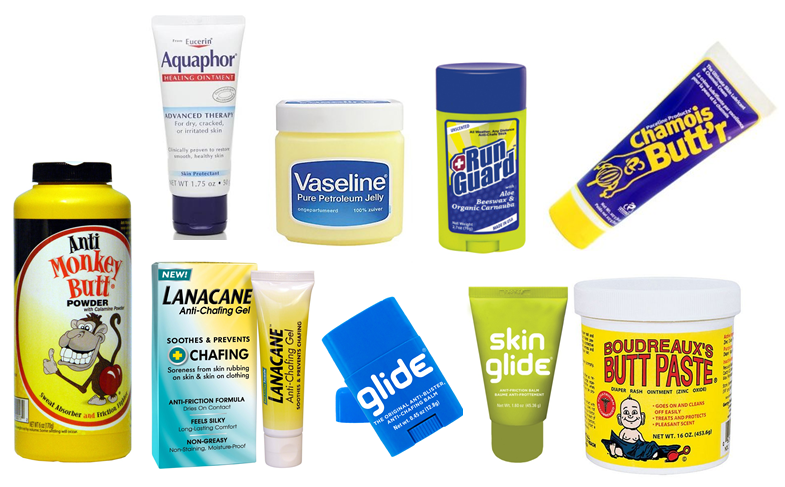 3. Slather it on. If a physical barrier doesn't work, try a topical cream or salve. There are many different topical products that you can wipe on, massage in, or roll on the affected areas in advance of your run to prevent chafing or to protect and already chafed area during your run. Some of these you may already have in your medicine cabinet. Vaseline and Aquaphor are two such products. Both can be used to help prevent chafing or to deal with it after you already have it. I've found that Vaseline is a bit messy, stains, and wears off quickly, but in a bind it's better than nothing. Aquaphor actually works really well. It lasts pretty long and doesn't seem to stain like Vaseline. It's also a great soother for chafed areas after the run. Another product you can find at the local pharmacy or drug store is Lanacane's Anti-Chafing Gel. This applies like a gel but quickly dries like a powder. Works pretty well. There are also many anti-chafing products made specifically for runners and cyclists. They include Body Glide, Skin Glide, Run Guard, Anti Monkey Butt Powder, Boudreaux's Butt Paste, and Chamois Butt'r. I personally use and like Body Glide. It comes in a container much like deodorant and you apply it to your skin much like you would deodorant.
4. Try it before Race Day! Whether it's race day clothing or one of the anti chafing products mentioned above, be sure to test them out on several runs prior to race day. Never, never, never, never wear new clothing on race day. Best to discover the shorts you purchased are really an inner thigh torture device disguised as running shorts during a training run rather than on race day. Same goes for the anti-chafing product sample somebody hands you at the race expo. Do not use it on your tender little nips or nether regions on race day if you've not tried it on a previous long run. You don't want to run the risk of it just plain not working or worse, having an allergic reaction to it!
Tuesday, June 16, 2015
Don't Sabotage Your Workout With A "Reward!"
 We are definitely a reward-based society. Every time we do something good, we want to be rewarded
or recognized. Nothing wrong with a reward, but let's save it for the big stuff, like finishing training for your first 5K race, crossing the finish line of a Marathon, or setting a new PR, not for finishing your Wednesday night workout.
We have all been guilty at times of using our "workout" as justification for having that treat. "Oh, I just worked out. Now I can have the beer, candy bar, triple chocolate brownie, sundae, or those fries....oh those fries."
Problem is the general public tends to way over estimate their calorie burn from a workout. To give you and idea of what I'm (male/5'6"/135lbs/50yrs old) actually burning in a typical 1-hour workout, check out the stats below:
Vigorous weight lifting = 372 calories
Circuit Training-Cross Fit = 518 calories
Vigorous Spinning Class = 696 calories
Running at a 10-min pace = 615 calories
Running at a 8:34-min pace = 704 calories
Keep in mind that the stats above are for 60 minutes of solid working out. Not one hour of doing some reps, talking with a friend, doing a few more reps, talking to another friend, and so on.
Big box gyms often come equipped with a smoothie or juice bar. Nothing wrong with that. I've even played around with the idea of offering them here at my fitness studio. Problem is, if you're not the one making the smoothie, you have no idea how many calories are going into that smoothie.
For example, Smoothie King's 20oz High Protein Chocolate Smoothie has 366 calories. So for my one hour of heavy weight lifting, I netted out with a burn of 6 calories, if I treat myself to this smoothie! BUT.....keep in mind ,the 20oz is their small. When I 've been at Smoothie King, I rarely see a person order a 20oz, unless it's for a kid. Usually patrons are ordering the 32oz or the 40oz. For that same Chocolate smoothie, the 32oz packs 549 cals and the 40oz packs a whopping 732 calories. So, if I ordered either of the 2 larger sizes, I've just taken in 177 or 360 more calories than I actually burned working out. Maybe if I had run for 60 mins the 20oz would be an appropriate refueling snack post workout. When I do my long 20+ milers, I make a pretty high calorie smoothie. I've burned about 2500 calories on the run and my smoothie that I make myself contains about 565 calories and is about 20oz.
You can quickly see if you're not aware of how many calories your burning and what you're treating yourself with post workout, you may just be sabotaging all your hard work. Now I'm not trying to make Smoothie King or any smoothie shop the bad guy. They have a product to sell and for the most part it's a good product. I've never been in a Smoothie King where they've tried to push the 40oz "The Hulk" strawberry smoothie with 1928 calories on me. It's up to me as the consumer to know what I'm eating or drinking.
So how much should you eat after a run? In her book, Food Guide for Marathoners, sports nutrition guru, Nancy Clark recommends you take in 200-400calories comprised of about 50-100g of carbs and about 10g of protein within an hour of running. I tell my runners to try and get it in within 30 mins of completing their run. Now keep in mind the range of 200-400 calories. 400 calories is more appropriate following a really hard speed workout or long run, while 200 calories is more appropriate following an easy run. My smoothie is a little more than the 400 calorie limit, but like I mentioned earlier, I only drink that after a 20+ mile run. Twelve ounces of 1% chocolate milk has 240 calories and 16g of protein. making it a perfect post-run recovery snack for a shorter less intense run. Other good options include Greek or traditional yogurt with added fruit, a bagel with peanut butter, an energy bar (be sure to read the label for calorie and carb/protein content), a peanut butter and banana sandwich, spaghetti with meat sauce, or a turkey sandwich, etc.
Celebrate the small gains you make in your fitness and running with the satisfaction of a job well done, and save those "treats" for the big long-term accomplishments. Save those extra calories for that celebratory victory meal with your friends and family.
Subscribe to:
Posts (Atom)